

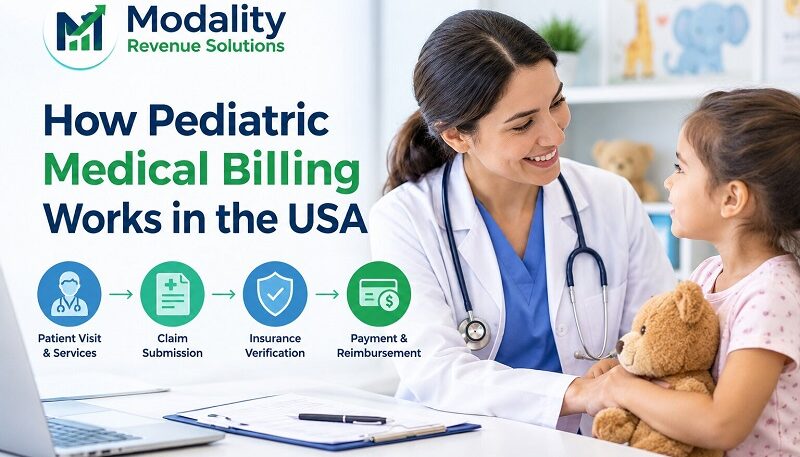
Pediatric medical billing is the process of turning each child’s visit, vaccine and screening into a clean insurance claim, then collecting payment from payers and families. It follows the same basic path as other specialties. But age-based preventive codes, vaccine programs and shared family coverage add extra detail.
This guide explains how pediatric medical billing works in the USA, step by step. It also covers the rules that trip up practices and what to look for in pediatric billing services.
What Makes Pediatric Healthcare Billing Different
Pediatric healthcare billing has features that adult practices rarely see.
- Preventive care drives the visit mix. Well-child visits, immunizations and screenings fill a large part of a pediatric schedule.
- Codes depend on age. The correct preventive code changes as a child moves from infancy to adolescence.
- Public coverage is common. Medicaid and CHIP cover a large share of children, and each state sets its own rules.
- Two parents, two plans. Many children are covered by more than one health plan, so coordination of benefits comes up often.
- High volume, modest claim values. Small errors add up quickly when a practice sends hundreds of claims.
These differences are why many practices look for pediatric medical billing services built around the specialty, instead of general billing support.
The Pediatric Billing Process: Step by Step
A clean pediatric billing process has eight steps. Each one protects revenue for the next.
- Registration and insurance verification: Collect the child’s details, guardian information and every active insurance policy. Verify eligibility and benefits before the visit, including preventive coverage, copays and deductibles. Many pediatric insurance billing problems start here.
- Documentation and charge capture: The provider documents the visit, and every billable service is captured: the exam, vaccines given, screenings and tests. A missed charge is lost revenue.
- Coding: Coders assign CPT codes for services and ICD-10-CM codes for diagnoses, based on the documentation. Age, visit type and payer rules all affect the choice.
- Claim creation and scrubbing: The claim is built on the CMS-1500 form or its electronic version, the 837P. A claim scrubber checks for missing data, mismatched codes and payer edits before the claim goes out.
- Claim submission: Claims usually go to payers through a clearinghouse. Submit quickly, because payers set timely filing deadlines.
- Payer adjudication: The payer reviews the claim and pays it, reduces it or denies it.
- Payment posting: Payments and adjustments are posted and matched to the remittance advice. Underpayments are flagged for follow-up.
- Denial management and patient billing: Denied claims are corrected and resubmitted, or appealed. Remaining balances go to the family on a clear, easy-to-read statement.
Common Pediatric Services and Codes
The table shows examples of codes used in pediatric healthcare billing. Codes change every year, and payers may add their own rules, so always check current references.
| Service | Example Codes | What to Watch |
| Preventive visit, new patient | 99381 to 99385 | Code is chosen by the child’s age |
| Preventive visit, established patient | 99391 to 99395 | Same, by age group |
| Sick visit | 99202 to 99215 | Level is based on medical decision making or time |
| Sick problem at a well visit | E/M code with modifier 25 | Needs its own documentation |
| Vaccine administration | 90460, 90461 or 90471 to 90474 | Depends on counseling and the patient’s age |
| Vaccine product | Code listed for each vaccine | Reported separately from administration |
| Developmental screening | 96110 | Needs a scored, standardized tool |
| Emotional or behavioral screening | 96127 | Needs a standardized instrument |
| Vision screening | 99173 | Quantitative visual acuity screening |
| Hearing screening | 92551 | Pure tone, air only |
Insurance and Programs That Shape Pediatric Insurance, Billing
The payer decides how a claim is paid, so knowing the main coverage types matters.
- Commercial plans: Most plans must cover recommended preventive services for children without cost sharing, but benefits and rules still vary by plan.
- Medicaid and EPSDT: Medicaid covers children through the Early and Periodic Screening, Diagnostic and Treatment benefit. It includes regular screenings and medically necessary treatment.
- CHIP: The Children’s Health Insurance Program covers many children who earn too much for Medicaid but cannot afford private coverage. States run it differently.
- Vaccines for Children (VFC): This federal program supplies vaccines at no cost for eligible children. Practices bill an administration fee, not the vaccine itself, and report the vaccine with the modifier their state requires. Many states use SL.
- Coordination of Benefits: When a child has two plans, the “birthday rule” often decides which is primary: the plan of the parent whose birthday falls earlier in the calendar year. Court orders can change this for separated parents.
Where Pediatric Billing Goes Wrong
A few problems cause most delays and denials.
- Coverage lapses. Children can lose Medicaid or CHIP coverage, or change plans, between visits.
- Missing modifier 25. A sick problem addressed at a well visit needs its own E/M code with modifier 25.
- Vaccine coding mistakes. Using the wrong administration code, or leaving off the VFC modifier, leads to denials or underpayment.
- Wrong age-based code. The preventive code must match the child’s age on the date of service.
- Late filing. Missed timely filing windows cannot usually be recovered.
- Unclear patient statements. Families who do not understand a balance are slower to pay.
Best Practices For a Smoother Pediatric Billing Process
- Verify insurance before every visit, not only at the first one.
- Train front-desk staff to capture all active policies.
- Use a claim scrubber with pediatric edits.
- Match vaccine and administration codes to documentation every time.
- Work denials weekly and track the reasons.
- Review coding updates each year, since CPT changes in January and ICD-10-CM changes in October.
- Send plain-language patient statements.
When Pediatric Billing Services Make Sense
Some practices handle billing in-house. Others use pediatric billing services when staffing is tight, denials are rising or coding rules are hard to keep up with.
When you compare pediatric medical billing services, ask these questions:
- Does the team have real pediatric experience?
- Do they handle VFC, Medicaid and CHIP rules in your state?
- Are the coders certified, and do they keep up with yearly updates?
- Will they work inside your EHR or practice management system?
- How often will you receive reports on denials, days in A/R and collections?
- How do they protect patient data under HIPAA?
Final thoughts
Pediatric medical billing rewards accuracy at every step, from insurance checks before the visit to follow-up on unpaid claims. Practices that verify coverage, code by age and visit type, and work denials quickly tend to see steadier cash flow.
If you want support with pediatric billing, [Company Name] can review your current process and show where claims are being delayed or denied. [CTA button: Request a Free Billing Review]
This article is for general information. Codes, guidelines and payer policies change, so verify current CPT, ICD-10-CM and payer rules before submitting claims.

